Friday, 18 October 2024

Joy in Humble Service Sub-Theme: Giving Toward the Acquiring of Land for the Construction of a Church Building    

Published from Blogger Prime Android App

20TH OCTOBER 2024AD 

Sermon 

Theme: Joy in Humble Service

Sub-Theme: Giving Toward the Acquiring of Land for the Construction of a Church Building


Scripture Readings

Isaiah 53:4-12

Hebrews 5:1-10

Mark 10:35-45 


Introduction:


Beloved in the Lord Jesus Christ, today’s theme, “Joy in Humble Service,” invites us to reflect on the heart of service serving others not for recognition but out of love, humility, and obedience to God. In our Christian journey, joy is not found in seeking glory for ourselves but in living lives that bless others. The sub-theme, “Giving toward the acquiring of land for the construction of a church building,” is an opportunity to live out this service by contributing to a vision that honors God.


We are called to partner in God’s work, not for personal gain but for the kingdom of God. Today, we draw lessons from our scripture readings to understand the essence of humble service and how it applies practically to giving.


A.     The Model of Humble Service (Isaiah 53:4-12)


Isaiah 53 presents us with the ultimate example of humility in the person of Jesus Christ. Though He was the Son of God, He humbled Himself, bearing the sins of the world and suffering for our sake. Verse 5 says, “He was wounded for our transgressions, He was bruised for our iniquities; the chastisement for our peace was upon Him, and by His stripes, we are healed.”


Jesus’ service was sacrificial. He didn’t serve with expectations of praise but out of love for humanity. His suffering was necessary for our salvation. This teaches us that humble service may not always be glamorous; it often requires sacrifice and commitment. But there is deep joy in knowing that, like Christ, we are part of something greater than ourselves.


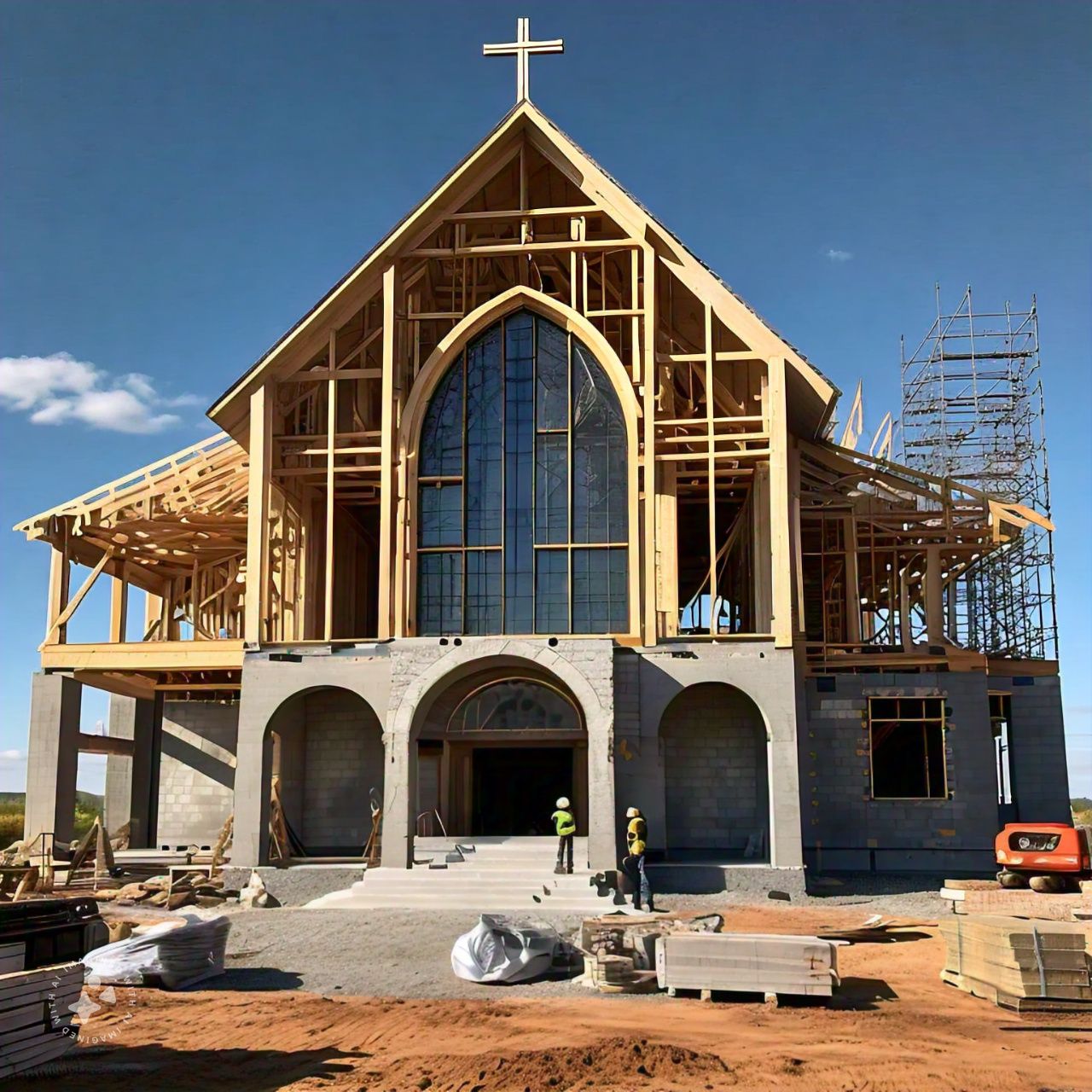
As we look toward acquiring land for PCG, Faith Preaching Point and building a church for future generations, we must embrace this same sacrificial spirit. Giving to the construction of a church building is not just about the physical structure but about creating a space where others will come to encounter God. It’s a service that outlives us, impacting countless souls.

 

 Published from Blogger Prime Android App

B.     Christ’s High Priestly Role and Our Call to Serve (Hebrews 5:1-10)


Hebrews 5 speaks of Christ as the great High Priest who, through His suffering, became the source of eternal salvation. Verses 7-8 say, “During the days of Jesus’ life on earth, He offered up prayers and petitions with fervent cries and tears to the one who could save Him from death, and He was heard because of His reverent submission. Although He was a son, He learned obedience from what He suffered.”


Obedience and humility are central to Christ’s ministry. As Christians, we are called to mirror these attributes in our service to God and others. Christ did not serve for His own benefit but for the benefit of humanity.


When we think about giving toward the acquisition of a land for the church, it requires a level of sacrifice and obedience. We may feel the strain financially, or we may feel as though our contribution is small, but it’s the obedience that matters. Just as Christ’s obedience brought salvation to many, our humble service through giving can create an environment where many will come to know the Lord.


C.    True Greatness in Service (Mark 10:35-45)


In Mark 10, we read about James and John asking Jesus for positions of prominence in His kingdom. Jesus responds by redefining greatness. Verses 43-45 say, “Whoever wants to become great among you must be your servant, and whoever wants to be first must be slave of all. For even the Son of Man did not come to be served, but to serve, and to give His life as a ransom for many.”


True greatness is found in service. The world teaches us to strive for recognition, but Christ teaches us that the path to joy and fulfillment is in serving others. If we seek positions of honor, we miss the point of Christian service. Instead, we must seek to serve.


This speaks to our giving as well. When we give toward the land we want to buy for the Faith Preaching Point and the building of a decent place of worship, we are serving God and His people. We may not receive recognition, but the joy comes in knowing that we are contributing to the advancement of God’s kingdom.


PRACTICAL APPLICATION: GIVING TOWARD THE PCG FAITH PREACHING POINT LAND AND CHURCH BUILDING


Now, let’s bring these principles into practical terms. As a church, we have a vision to acquire land and construct a building for worship and ministry. This is a great mission, and it requires all of us to come together in humble service.


FIRST, See Your Giving as a Spiritual Investment

When you give toward the church, you’re not just donating money; you’re investing in a spiritual legacy. Think of the generations who will be blessed by your sacrifice today. Like the prophets and apostles who laid the foundation of the church, you are laying a foundation for future Christians.


SECOND, Give with a Heart of Joy, Not Compulsion

Scripture tells us that “God loves a cheerful giver” (2 Corinthians 9:7). Your contribution, no matter how small or large, is valuable in God’s eyes. Give because you are grateful for what God has done for you, and give with joy knowing that you are participating in something eternal.


THIRDLY,  Trust in God’s Provision

Just as God provided for the widow in Zarephath when she gave her last bit of flour and oil to the prophet Elijah (1 Kings 17:8-16), God will provide for you when you give out of faith. Don’t be afraid to give sacrificially. God knows your needs and will take care of you.


FOURTH, Unite in Purpose and Prayer 

This is a collective mission. Let’s come together as one body, united in purpose. As we work toward this goal, let us pray for guidance, provision, and wisdom. Let us ask God to bless this effort and use it for His glory.


Conclusion


Beloved in the Lord, Father and Mothers, Brothers and sisters, the joy of humble service lies in giving without expecting anything in return from man but rather expecting the God will bless you, just as Christ gave Himself for us, and the Lord lifted Him up above all. As we embark on this mission to acquire land and build a church, let us do so with hearts full of joy, knowing that our service, like Christ’s, will have a lasting impact.


May we be reminded that it’s not about how much we give but the heart with which we give. Let us find joy in serving God and His people, and may this project be a testimony of our love for Christ and His church.


Amen.

Prayer

Apostle Creed

Saturday, 12 October 2024

JESUS CHRIST, THE ALPHA AND THE OMEGA; EDUCATION WITH CHRISTIAN VALUES FOR TRANSFORMATION

Published from Blogger Prime Android App

EDUCATION SUNDAY 

Sermon By: Rev. Immanuel A. Wiafe 

JESUS CHRIST, THE ALPHA AND THE OMEGA; EDUCATION WITH CHRISTIAN VALUES FOR TRANSFORMATION


Scripture Readings 

First Reading: Daniel 1:8-16 

Second Reading: Revelation 21:6 

Third Reading: Matthew 5:13-16 


INTRODUCTION


Beloved in Christ, today we gather under the powerful theme, "Jesus Christ, the Alpha and the Omega: Education with Christian Values for Transformation." As we delve into this theme, we are called to reflect on the state of education today, which is increasingly distancing itself from Christian values. How does this affect the moral and spiritual fabric of society? What is our role, as followers of Christ, in ensuring that education becomes a tool for transformation anchored in the Word of God?


.. From our First Scripture Reading

The Power of Conviction in a Secular World (Daniel 1:8-16)


In our first reading, we see the story of Daniel and his friends who, despite being immersed in a foreign and secular system, resolved not to defile themselves with the king's food and drink. They stood firm in their convictions, rooted in their faith in God. This passage speaks directly to the situation we find ourselves in today. The current education system, both locally and globally, is often devoid of Christian values, promoting a worldview that ignores or even opposes biblical principles.


Yet, Daniel's story shows us that it is possible to thrive in such an environment without compromising one's faith. Daniel and his friends were tested, but they came out healthier and stronger, not because of their environment, but because of their unwavering commitment to God. This calls us to stand firm in our faith and impart these values to the next generation, encouraging them to navigate the challenges of a secular educational system with Christian convictions.


...From our Second Scripture Reading

Jesus Christ, the Source of Life and Truth (Revelation 21:6)


In Revelation 21:6, we read the words of Jesus: "I am the Alpha and the Omega, the Beginning and the End." This powerful declaration reminds us that Christ is the source and culmination of all truth and knowledge. Education without the foundation of Christian values is incomplete because it neglects the ultimate truth found in Christ.


As the Alpha and Omega, Jesus is central to all areas of life, including education. The current challenges we face in the educational system ranging from moral relativism, materialism, to a lack of ethical grounding can be traced to the exclusion of God from the curriculum. We must advocate for an education that recognizes Jesus as the ultimate source of wisdom, and instill in our students a sense of purpose that transcends worldly success. Without Christ, education loses its transformative power. With Him, it becomes a tool for shaping individuals who are not only knowledgeable but also spiritually grounded and morally upright.


...From our Third Scripture Reading

The Role of Christians as Salt and Light (Matthew 5:13-16)


In Matthew 5:13-16, Jesus calls His followers the "salt of the earth" and the "light of the world." Salt preserves and enhances flavor, while light dispels darkness. In the context of education, we are called to be salt and light, preserving the values that promote justice, compassion, integrity, and truth. We are to shine the light of Christ in educational systems that may be steeped in secularism, ensuring that students encounter the transformative power of Christian values.


As Christians, we have a responsibility to engage with the educational sector, advocating for curricula that promote not just academic excellence, but moral and spiritual development. This may mean pushing back against teachings that are contrary to Christian beliefs, encouraging the integration of biblical principles in school settings, or simply mentoring young people to live out their faith boldly in academic environments. We must not retreat from the challenges but be active participants in shaping an education system that reflects the kingdom of God.

 Published from Blogger Prime Android App

...AN OBSERVATION!

The Current Challenges in Education Without Christian Values


1. Moral Relativism: Today, truth is often presented as subjective, where students are taught that "right" and "wrong" are flexible concepts. Without the absolute truth found in Jesus Christ, young people are left to define their own morality, which leads to confusion and a lack of ethical standards.


2. Focus on Materialism: Education has become more about achieving worldly success measured in wealth, power, and fame than about nurturing holistic, godly individuals. Christian values, however, remind us that true success is found in living a life that pleases God.


3. Lack of Purpose: Many students graduate with skills but lack a sense of purpose and direction. Christian education offers not just knowledge, but a sense of calling, helping students understand that their talents and education should be used for the glory of God and the good of humanity.


CONCLUSION


Brothers and sisters, the challenges we face in today's educational system are real, but we are not without hope. Jesus Christ, the Alpha and the Omega, is the source of all wisdom, and His Word provides the foundation for a transformative education. As Christians, we are called to be salt and light in this world, ensuring that education is not merely a process of acquiring knowledge, but a journey of spiritual and moral development.


Let us commit to advocating for education with Christian values an education that forms individuals who will not only excel academically but also live lives of integrity, compassion, and faithfulness to God. In doing so, we contribute to a world where education leads to true transformation, grounded in the eternal truth of Christ.


Amen.


Let’s us share a word of prayer...

Oh Lord we thank for your inspiring words. Thank you for making us doers and not just hearers. Amen


Let’s affirm our faith in the Apostle Creed...


Saturday, 5 October 2024

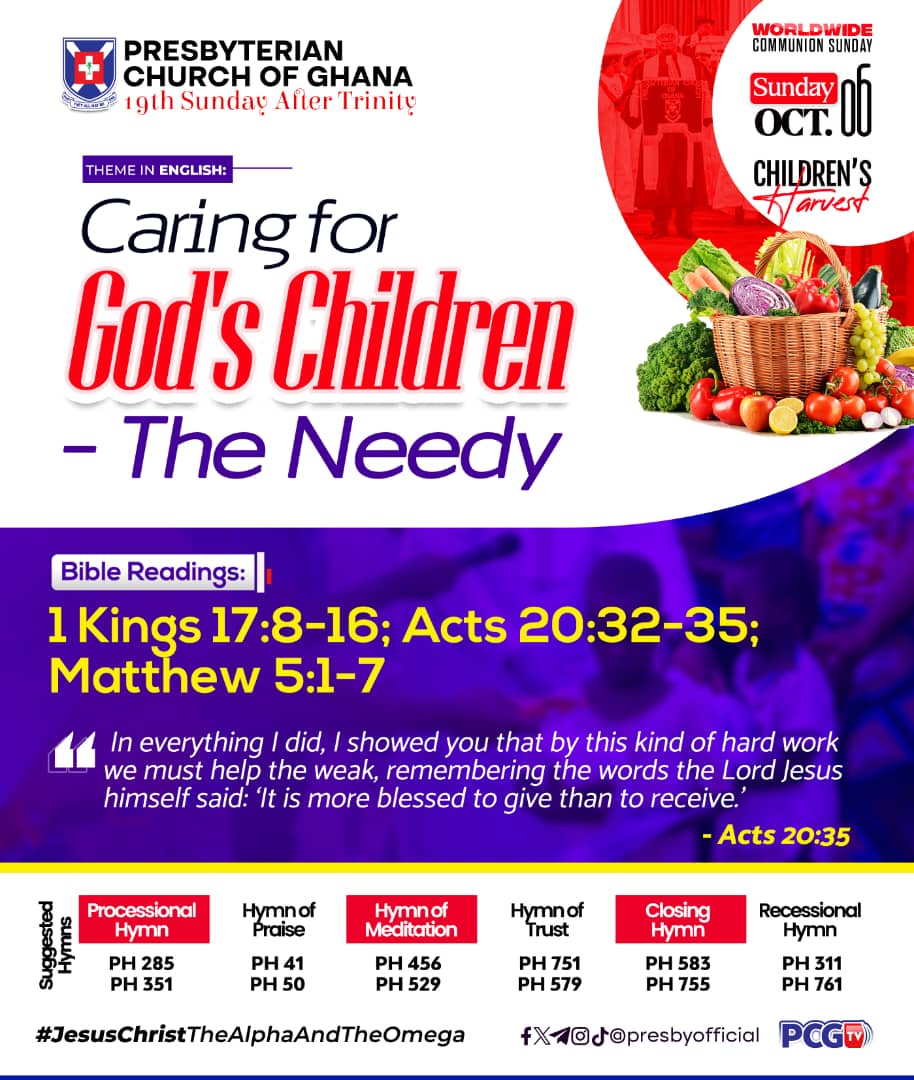
CARING FOR GOD'S CHILDREN

Published from Blogger Prime Android App

SUNDAY, 6TH OCTOBER 2024


TEXTS:

1. 1 Kings 17:8-16

2. Acts 20:32-35

3. Matthew 5:1-7


THEME: -

"Caring for God's Children - The Needy" 

(Yɛrehwɛ Onyankopɔn Mma – Obi A Biribi Hia No) 


19th Sunday After Trinity / Worldwide Communion Day / Children's Harvest


"Thou shall open thine hand wide unto thy brother, to thy poor, and to thy needy in thy land." Deuteronomy 15:11


Today is Worldwide Communion Day, where the Saints in Christ Jesus, the Church Militant, are called to partake in the Lord's Table. The Lord's Supper, or the Eucharist, holds great importance for the believer:


1. It serves as a remembrance of Christ's sacrificial death on the Cross and His victorious Resurrection.

2. It offers spiritual nourishment, strengthening the faith and fostering the spiritual growth of participants.

3. It symbolizes our union with Christ Jesus and fellowship with other believers.

4. It reminds us of Christ's forgiveness and cleansing from sin.

5. It encourages believers to anticipate the Second Coming of Christ Jesus.


While we partake in the Eucharist, the theme today reminds us not to lose focus on our social well-being. We are called to care for the needy among us a responsibility we often overlook.


CARING FOR OTHERS

God has given us a divine mandate to care for one another and seek our collective well-being. During the Sermon on the Mount, Jesus stressed the importance of mercy, saying, "Blessed are the merciful, for they shall obtain mercy" (Matthew 5:7). A merciful heart is essential in assisting those in need.


Jesus set an example by identifying the needy and extending help to them, for "He went around doing good" (Acts 10:38, Matthew 4:23-25). His early ministry focused on the poor, as He declared, "The Spirit of the Lord is upon me, for He has anointed me to bring good news to the poor" (Luke 4:18). Caring for others is not just an act of kindness it is a practical way of demonstrating Christ-like nature. Sadly, many believers have neglected this crucial aspect of their calling.

 Published from Blogger Prime Android App


CARING FOR THE NEEDY

At different points in our lives, we all experience need and rely on others to provide for us. The widow of Zarephath, for example, needed divine intervention in her time of scarcity. Prophet Elijah was sent to fulfill this need, demonstrating that God can use any person or circumstance to meet our needs (1 Kings 17:8-16).


WHO IS A NEEDY PERSON?

A needy person is someone who requires assistance to meet their basic physical, emotional, or spiritual needs. This includes:


- The homeless and hungry

- The mentally ill, sick, or disabled

- The elderly or vulnerable adults

- Orphans and abandoned children

- Those struggling with addiction

- Victims of abuse

- Refugees and displaced persons 


Even unbelievers are spiritually needy, as they lack the saving grace of Christ Jesus.


WHY CARE FOR THE NEEDY?

God commands us to care for the needy for several reasons:


1. It is a command from God: 

   God instructed the Israelites to leave the corners of their fields unharvested for the poor and strangers (Leviticus 19:9-10, Deuteronomy 24:19), teaching us to demonstrate compassion and generosity.


2. It brings God's blessings: 

   "He who hath a bountiful eye shall be blessed, for he giveth his bread to the poor" (Proverbs 22:9).

As Pastor E. A. Adeboye said, "One of the quickest ways to be blessed by God is to care for the poor." 

   Givers never lack!


3. It fosters multiplication: 

   The widow's flour was multiplied after she gave a little of what was left for her to eat with her child and die (1 Kings 17:16). God presses and shakes our resources to overflow when we extend help to the needy.


4. It blesses others: 

   God blesses us so that we may bless others (*Genesis 12:2*). Can you bless someone today?


5. It is a form of worship: 

   Helping the poor is an act of worship, as Proverbs 14:31 says, "Kindness shown to the poor is an act of worship."


THE PRINCIPLES

1. Treat the needy with integrity: 

We must respect the dignity of the needy, remembering that our self-worth is not measured by material wealth.


2. Give opportunities: 

   It's not always about giving money. The needy may require training, jobs, or mentorship to rise above their circumstances (Galatians 6:10).


3. Defend the poor: 

   The needy are vulnerable to injustice. We must stand up for them, ensuring systems are in place to protect them from mistreatment.


4. Share what you have: 

   Share your food, home, and clothes with the needy, and do not turn away those you can help (Isaiah 58:7).


CAUTION

Helping the needy should not make people lazy or idle but should enable them to live meaningful lives. The Bible warns us against associating with lazy people (2 Thessalonians 3:7). We should also be careful not to exploit or abuse those we help.


Our generosity reflects the health of our spiritual lives. A generous heart is a sign of godliness, while indifference and greed reveal a corrupt heart. "Giving to the needy is lending to the Lord, and He will repay whatever is given" (Proverbs 19:17). God is displeased when we ignore the cries of the needy. Though you may be taken for granted for your kindness, never grow weary in doing good.


AMEN.

Caring for God's Children - The Needy 

Published from Blogger Prime Android App

SUNDAY, 6TH OCTOBER 2024


TEXTS:

1. 1 Kings 17:8-16

2. Acts 20:32-35

3. Matthew 5:1-7


THEME: -

"Caring for God's Children - The Needy" 

(Yɛrehwɛ Onyankopɔn Mma – Obi A Biribi Hia No) 


19th Sunday After Trinity / Worldwide Communion Day / Children's Harvest


"Thou shall open thine hand wide unto thy brother, to thy poor, and to thy needy in thy land." Deuteronomy 15:11


Today is Worldwide Communion Day, where the Saints in Christ Jesus, the Church Militant, are called to partake in the Lord's Table. The Lord's Supper, or the Eucharist, holds great importance for the believer:


1. It serves as a remembrance of Christ's sacrificial death on the Cross and His victorious Resurrection.

2. It offers spiritual nourishment, strengthening the faith and fostering the spiritual growth of participants.

3. It symbolizes our union with Christ Jesus and fellowship with other believers.

4. It reminds us of Christ's forgiveness and cleansing from sin.

5. It encourages believers to anticipate the Second Coming of Christ Jesus.


While we partake in the Eucharist, the theme today reminds us not to lose focus on our social well-being. We are called to care for the needy among us a responsibility we often overlook.


CARING FOR OTHERS

God has given us a divine mandate to care for one another and seek our collective well-being. During the Sermon on the Mount, Jesus stressed the importance of mercy, saying, "Blessed are the merciful, for they shall obtain mercy" (Matthew 5:7). A merciful heart is essential in assisting those in need.


Jesus set an example by identifying the needy and extending help to them, for "He went around doing good" (Acts 10:38, Matthew 4:23-25). His early ministry focused on the poor, as He declared, "The Spirit of the Lord is upon me, for He has anointed me to bring good news to the poor" (Luke 4:18). Caring for others is not just an act of kindness it is a practical way of demonstrating Christ-like nature. Sadly, many believers have neglected this crucial aspect of their calling.


CARING FOR THE NEEDY

At different points in our lives, we all experience need and rely on others to provide for us. The widow of Zarephath, for example, needed divine intervention in her time of scarcity. Prophet Elijah was sent to fulfill this need, demonstrating that God can use any person or circumstance to meet our needs (1 Kings 17:8-16).


WHO IS A NEEDY PERSON?

A needy person is someone who requires assistance to meet their basic physical, emotional, or spiritual needs. This includes:


- The homeless and hungry

- The mentally ill, sick, or disabled

- The elderly or vulnerable adults

- Orphans and abandoned children

- Those struggling with addiction

- Victims of abuse

- Refugees and displaced persons 


Even unbelievers are spiritually needy, as they lack the saving grace of Christ Jesus.


WHY CARE FOR THE NEEDY?

God commands us to care for the needy for several reasons:


1. It is a command from God: 

   God instructed the Israelites to leave the corners of their fields unharvested for the poor and strangers (Leviticus 19:9-10, Deuteronomy 24:19), teaching us to demonstrate compassion and generosity.


2. It brings God's blessings: 

   "He who hath a bountiful eye shall be blessed, for he giveth his bread to the poor" (Proverbs 22:9).

As Pastor E. A. Adeboye said, "One of the quickest ways to be blessed by God is to care for the poor." 

   Givers never lack!


3. It fosters multiplication: 

   The widow's flour was multiplied after she gave a little of what was left for her to eat with her child and die (1 Kings 17:16). God presses and shakes our resources to overflow when we extend help to the needy.


4. It blesses others: 

   God blesses us so that we may bless others (*Genesis 12:2*). Can you bless someone today?


5. It is a form of worship: 

   Helping the poor is an act of worship, as Proverbs 14:31 says, "Kindness shown to the poor is an act of worship."


THE PRINCIPLES

1. Treat the needy with integrity: 

We must respect the dignity of the needy, remembering that our self-worth is not measured by material wealth.


2. Give opportunities: 

   It's not always about giving money. The needy may require training, jobs, or mentorship to rise above their circumstances (Galatians 6:10).


3. Defend the poor: 

   The needy are vulnerable to injustice. We must stand up for them, ensuring systems are in place to protect them from mistreatment.


4. Share what you have: 

   Share your food, home, and clothes with the needy, and do not turn away those you can help (Isaiah 58:7).


CAUTION

Helping the needy should not make people lazy or idle but should enable them to live meaningful lives. The Bible warns us against associating with lazy people (2 Thessalonians 3:7). We should also be careful not to exploit or abuse those we help.


Our generosity reflects the health of our spiritual lives. A generous heart is a sign of godliness, while indifference and greed reveal a corrupt heart. "Giving to the needy is lending to the Lord, and He will repay whatever is given" (Proverbs 19:17). God is displeased when we ignore the cries of the needy. Though you may be taken for granted for your kindness, never grow weary in doing good.


AMEN.

Saturday, 7 September 2024

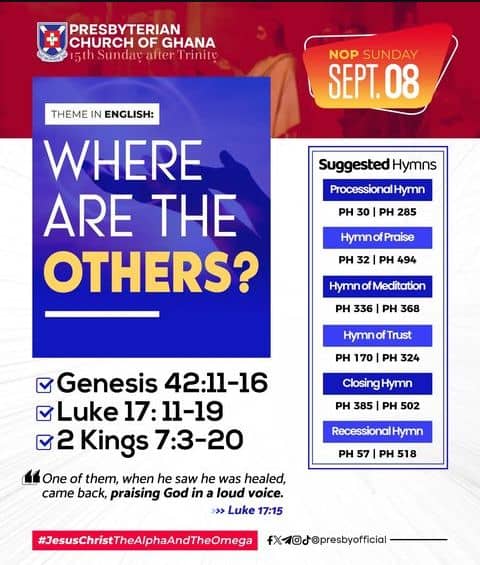
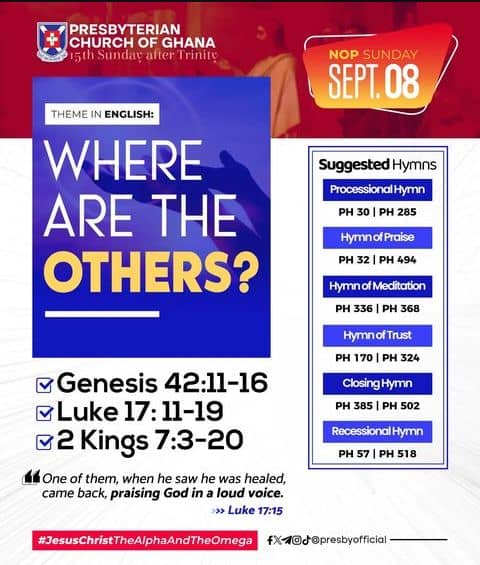
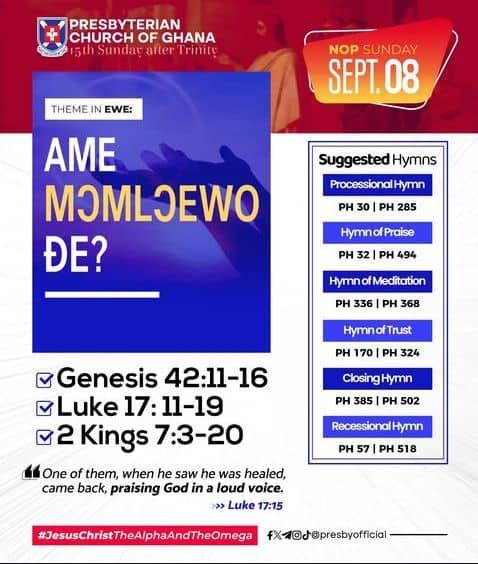
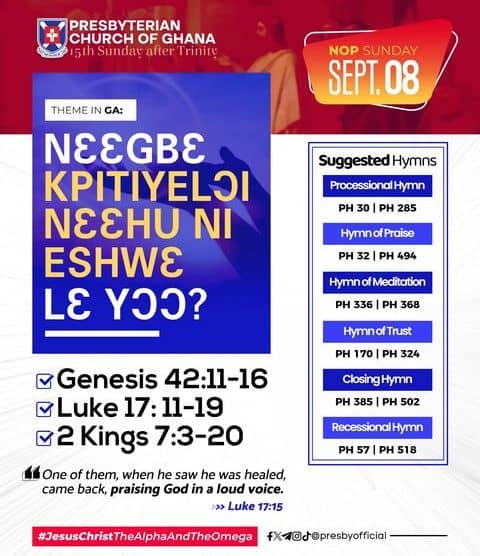
WHERE ARE THE OTHERS?


Published from Blogger Prime Android AppSERMON ON THE THEME: WHERE ARE THE OTHERS?

Scriptural Texts

1st Bible Reading: Genesis 42:11-16

2nd Bible Reading: Luke 17:11-19

3rd Bible Reading: 2 Kings 7:3-20

Let’s Pray...

Greet the one sitting closer to you and welcome him or her to church service today


Imagine a moment when everything in your life has changed a time when you've received a blessing or a breakthrough you never expected. You feel the weight of relief, the joy of deliverance, or the excitement of new possibilities. Now, imagine looking around and realizing that others who were with you, hoping and waiting for the same blessing, are nowhere to be found. They received what they asked for, but they are gone.


Have you ever wondered, 'Where are the others?' This question is not just for today it has echoed through time, from the ancient fields of Egypt, to the dusty roads of Jerusalem, to the gates of Samaria. It's a question that asks us to look beyond ourselves and to think deeply about those who are missing, those who have yet to return, and those who are still waiting. It is a question that can change how we see our faith, our blessings, and our responsibility to one another. So today, let’s explore this question together: 'Where are the others?'


INTRODUCTION


We live in a rapidly changing world, where the pace of life often pulls us in many directions, making it easy to focus solely on our own needs and challenges. Yet, as followers of Christ, we are called to look beyond ourselves and ask, "Where are the others?" This question is not just about those who are physically absent; it is a question that speaks to the heart of our faith. It challenges us to think about the people in our lives, our communities, and our world who are not yet experiencing the fullness of God's grace, mercy, and love.


In the Story of Joseph's Brothers: A Lesson in Responsibility and Reconciliation is what we learn


GENESIS 42:11-16


In Genesis 42, we find the brothers of Joseph standing before him in Egypt, unaware that the powerful man they were speaking to was their own brother, whom they had sold into slavery many years earlier. A severe famine had struck their homeland, forcing them to come to Egypt to buy grain. Joseph, recognizing his brothers, puts them to the test, accusing them of being spies and demanding, "Where are the others?" specifically referring to their youngest brother, Benjamin.


CONTEXT AND REFLECTION


Joseph's question reveals much more than a concern for Benjamin's whereabouts. It exposes the brothers' past wrongdoings and brings them face to face with their guilt. For years, they had lived in deceit, hiding their betrayal of Joseph from their father, Jacob, and from themselves. Now, they are confronted with their past, and the question "Where are the others?" becomes a call to accountability and repentance.


As the Apostle Paul writes in 2 Corinthians 5:18-19, "All this is from God, who reconciled us to himself through Christ and gave us the ministry of reconciliation: that God was reconciling the world to himself in Christ, not counting people's sins against them."


HOW DOES THIS APPLY TO US IN THIS 21ST CENTURY AGE?


How does this story speak to us today? In our own lives, we often find ourselves in situations where reconciliation is needed with family members, friends, colleagues, or within our communities. In a world filled with division, conflict, and misunderstanding, we are challenged to ask ourselves: "Where are the others I have left out, hurt, or neglected?" Think about relationships that might need healing in your life. Are there people you’ve hurt, consciously or unconsciously, whom you need to reach out to for reconciliation? Or are there individuals you have been estranged from because of pride, anger, or misunderstanding?


PRACTICAL STEPS FOR RECONCILIATION


1. Pray for guidance to recognize where reconciliation is needed in your life.

2. Reach out to those you need to reconcile with a simple call, text, or visit can be the first step.

3. Seek forgiveness or offer it with a humble heart, recognizing that reconciliation is a process that often takes time.

4. Commit to healing relationships, knowing that God is with you in every step toward restoration.


With the story of the Ten Lepers: A Lesson in Gratitude is learnt here


LUKE 17:11-19


In Luke 17, we encounter Jesus on His way to Jerusalem, passing through a village where ten lepers cry out for mercy. Jesus responds to their plea and instructs them to go show themselves to the priests. As they obey, they are miraculously healed. But only one of them, a Samaritan, returns to Jesus, praising God and giving thanks. Jesus asks, “Were not all ten cleansed? Where are the other nine?”


CONTEXT AND REFLECTION


Jesus' question, "Where are the others?" is an indictment of ingratitude. The other nine lepers received physical healing but failed to recognize the deeper spiritual gift they had received. They took their blessing and continued on their way, missing an opportunity for a greater encounter with Jesus. The one who returned was not only healed physically but also received a blessing of wholeness, as Jesus declared, “Your faith has made you well.”


As the Psalmist writes in Psalm 100:4-5, "Enter his gates with thanksgiving and his courts with praise; give thanks to him and bless his name. For the Lord is good and his love endures forever; his faithfulness continues through all generations."


HOW DOES THIS APPLY TO US IN THIS 21ST CENTURY AGE?


In our modern lives, filled with distractions and pressures, gratitude can often be overlooked. We are quick to seek God's help in times of trouble but slow to return to Him with thanksgiving once our prayers are answered. Jesus' question, “Where are the others?” invites us to examine our own hearts. Are we living lives marked by gratitude, or are we among the nine who move on without acknowledging God's goodness?


PRACTICAL WAYS TO CULTIVATE GRATITUDE


1. Begin each day with thanksgiving by writing down three things you are grateful for.

2. Express gratitude to others regularly whether through words, notes, or acts of kindness.

3. Pray with a thankful heart, acknowledging God's goodness even in difficult times.

4. Celebrate God's blessings openly, sharing testimonies of His faithfulness with others.


The Four Lepers Story: A Lesson in Sharing Blessings is learnt here


2 KINGS 7:3-20


In 2 Kings 7, we read about four lepers who were living outside the gates of Samaria during a severe famine. Desperate, they decide to go to the enemy's camp, hoping for mercy. To their surprise, they find the camp deserted, abandoned by the enemy army who fled in fear, leaving behind food, gold, and supplies. The lepers initially keep this good news to themselves, but then realize, "We are not doing right. This is a day of good news, and we are keeping it to ourselves… Let us go and tell the people."


CONTEXT AND REFLECTION


The lepers' realization prompts them to ask, “Where are the others?” They could have hoarded their discovery, but instead, they chose to share it with the starving city. Their actions led to the salvation of many lives. This story illustrates the importance of sharing God's blessings with others, God’s Word with others, recognizing that what we receive from God is not meant for us alone.


As the Apostle Paul writes in Acts 20:35, "In everything I did, I showed you that by this kind of hard work we must help the weak, remembering the words the Lord Jesus himself said: 'It is more blessed to give than to receive.'"


HOW DOES THIS APPLY TO US IN THIS 21ST CENTURY AGE?


In today’s world, we are often encouraged to focus on accumulation of wealth, resources, and even spiritual experiences. Yet, God calls us to a different path: one of generosity, compassion, and sharing. We are blessed to be a blessing to others. Are there ways in which we are hoarding the blessings God has given us? Are there opportunities to share our resources, time, talents, and love with those in need?


PRACTICAL WAYS TO SHARE BLESSINGS


1. Give generously to those in need, whether through your church, charitable organizations, or directly to individuals.

2. Volunteer your time and talents in areas where you can make a difference — tutoring, mentoring, community service, or church activities.

3. Encourage others with words of kindness, support, and the hope found in Christ.

4. Be a witness of God’s love in your workplace, neighborhood, or social circles, sharing the good news of Jesus whenever the opportunity arises.


CONCLUSION


“Where are the others?” is a powerful question that compels us to look beyond ourselves. It is a call to action to seek reconciliation, live in gratitude, and share our blessings. As we move through our daily lives, may we be mindful of those around us, asking ourselves, "Where are the others?" and responding with hearts full of love, compassion, and grace. Let us commit today to be like Joseph, seeking reconciliation; like the Samaritan leper, overflowing with gratitude; and like the four lepers, eager to share the good news. May we never lose sight of the others in our midst who need to experience God's love through us. May we be the hands and feet of Jesus, bringing His light into a world in need.


Final thoughts:


As we live here for our various homes, work place and other businesses, remember that the question "Where are the others?" is not just a rhetorical one, but a call to action. It challenges us to examine our lives, our relationships, and our communities. It invites us to seek reconciliation, to live with gratitude, and to share our blessings with others.


In a world filled with division, strife, and inequality, may we be the ones who bridge the gaps, who bring people together, and who share the love of Christ with all. May we be the ones who ask, "Where are the others?" and then take steps to find them, to serve them, and to love them.


As the Apostle Paul writes in Galatians 6:2, "Carry each other's burdens, and in this way you will fulfill the law of Christ." May we carry the burdens of those around us, may we share their struggles, and may we point them to the hope and love of Jesus.


In the end, the question "Where are the others?" is not just about finding others, but about becoming the kind of people who reflect the heart of God. May we be those people, and may our lives be a testament to the power of love, compassion, and grace.


LET US PRAY…


Dear Heavenly Father, thank you for challenging us to ask, "Where are the others?" Help us to seek reconciliation, to live with gratitude, and to share our blessings with others. Give us eyes to see those around us, HEARTS TO LOVE THEM, AND HANDS TO SERVE THEM. May we be your instruments of love and grace in a world in need. In Jesus' name, we pray. Amen!


BLESSING


May the Lord bless you and keep you; may the Lord make his face shine upon you and be gracious to you; may the Lord turn his face toward you and give you peace. And may you always remember, when you ask, "Where are the others?" you are not just finding them, but becoming the kind of person who reflects the heart of God. Go in peace.


Friday, 6 September 2024

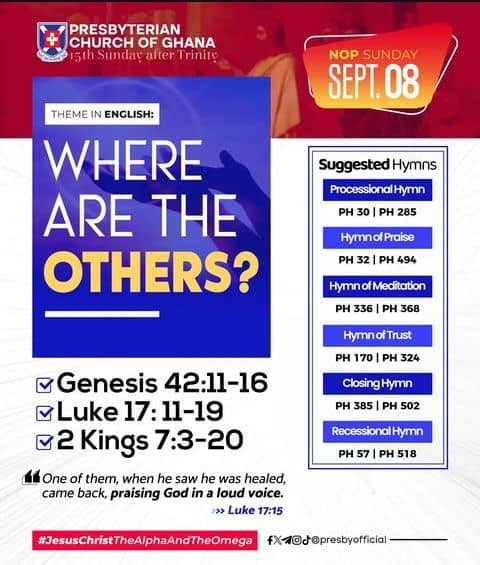
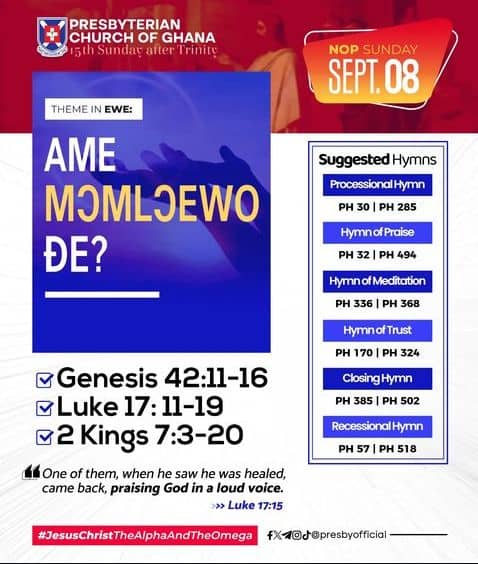
WHERE ARE THE OTHERS?

Published from Blogger Prime Android App

SERMON ON THE THEME: WHERE ARE THE OTHERS?

Scriptural Texts

1st Bible Reading: Genesis 42:11-16

2nd Bible Reading: Luke 17:11-19

3rd Bible Reading: 2 Kings 7:3-20

Let’s Pray...

Greet the one sitting closer to you and welcome him or her to church service today


Imagine a moment when everything in your life has changed a time when you've received a blessing or a breakthrough you never expected. You feel the weight of relief, the joy of deliverance, or the excitement of new possibilities. Now, imagine looking around and realizing that others who were with you, hoping and waiting for the same blessing, are nowhere to be found. They received what they asked for, but they are gone.


Have you ever wondered, 'Where are the others?' This question is not just for today it has echoed through time, from the ancient fields of Egypt, to the dusty roads of Jerusalem, to the gates of Samaria. It's a question that asks us to look beyond ourselves and to think deeply about those who are missing, those who have yet to return, and those who are still waiting. It is a question that can change how we see our faith, our blessings, and our responsibility to one another. So today, let’s explore this question together: 'Where are the others?'

 Published from Blogger Prime Android App

INTRODUCTION


We live in a rapidly changing world, where the pace of life often pulls us in many directions, making it easy to focus solely on our own needs and challenges. Yet, as followers of Christ, we are called to look beyond ourselves and ask, "Where are the others?" This question is not just about those who are physically absent; it is a question that speaks to the heart of our faith. It challenges us to think about the people in our lives, our communities, and our world who are not yet experiencing the fullness of God's grace, mercy, and love.


In the Story of Joseph's Brothers: A Lesson in Responsibility and Reconciliation is what we learn


GENESIS 42:11-16


In Genesis 42, we find the brothers of Joseph standing before him in Egypt, unaware that the powerful man they were speaking to was their own brother, whom they had sold into slavery many years earlier. A severe famine had struck their homeland, forcing them to come to Egypt to buy grain. Joseph, recognizing his brothers, puts them to the test, accusing them of being spies and demanding, "Where are the others?" specifically referring to their youngest brother, Benjamin.


CONTEXT AND REFLECTION


Joseph's question reveals much more than a concern for Benjamin's whereabouts. It exposes the brothers' past wrongdoings and brings them face to face with their guilt. For years, they had lived in deceit, hiding their betrayal of Joseph from their father, Jacob, and from themselves. Now, they are confronted with their past, and the question "Where are the others?" becomes a call to accountability and repentance.


As the Apostle Paul writes in 2 Corinthians 5:18-19, "All this is from God, who reconciled us to himself through Christ and gave us the ministry of reconciliation: that God was reconciling the world to himself in Christ, not counting people's sins against them."


HOW DOES THIS APPLY TO US IN THIS 21ST CENTURY AGE?


How does this story speak to us today? In our own lives, we often find ourselves in situations where reconciliation is needed with family members, friends, colleagues, or within our communities. In a world filled with division, conflict, and misunderstanding, we are challenged to ask ourselves: "Where are the others I have left out, hurt, or neglected?" Think about relationships that might need healing in your life. Are there people you’ve hurt, consciously or unconsciously, whom you need to reach out to for reconciliation? Or are there individuals you have been estranged from because of pride, anger, or misunderstanding?


PRACTICAL STEPS FOR RECONCILIATION


1. Pray for guidance to recognize where reconciliation is needed in your life.

2. Reach out to those you need to reconcile with a simple call, text, or visit can be the first step.

3. Seek forgiveness or offer it with a humble heart, recognizing that reconciliation is a process that often takes time.

4. Commit to healing relationships, knowing that God is with you in every step toward restoration.

 Published from Blogger Prime Android App

With the story of the Ten Lepers: A Lesson in Gratitude is learnt here


LUKE 17:11-19


In Luke 17, we encounter Jesus on His way to Jerusalem, passing through a village where ten lepers cry out for mercy. Jesus responds to their plea and instructs them to go show themselves to the priests. As they obey, they are miraculously healed. But only one of them, a Samaritan, returns to Jesus, praising God and giving thanks. Jesus asks, “Were not all ten cleansed? Where are the other nine?”


CONTEXT AND REFLECTION


Jesus' question, "Where are the others?" is an indictment of ingratitude. The other nine lepers received physical healing but failed to recognize the deeper spiritual gift they had received. They took their blessing and continued on their way, missing an opportunity for a greater encounter with Jesus. The one who returned was not only healed physically but also received a blessing of wholeness, as Jesus declared, “Your faith has made you well.”


As the Psalmist writes in Psalm 100:4-5, "Enter his gates with thanksgiving and his courts with praise; give thanks to him and bless his name. For the Lord is good and his love endures forever; his faithfulness continues through all generations."

 Published from Blogger Prime Android App

HOW DOES THIS APPLY TO US IN THIS 21ST CENTURY AGE?


In our modern lives, filled with distractions and pressures, gratitude can often be overlooked. We are quick to seek God's help in times of trouble but slow to return to Him with thanksgiving once our prayers are answered. Jesus' question, “Where are the others?” invites us to examine our own hearts. Are we living lives marked by gratitude, or are we among the nine who move on without acknowledging God's goodness?


PRACTICAL WAYS TO CULTIVATE GRATITUDE


1. Begin each day with thanksgiving by writing down three things you are grateful for.

2. Express gratitude to others regularly whether through words, notes, or acts of kindness.

3. Pray with a thankful heart, acknowledging God's goodness even in difficult times.

4. Celebrate God's blessings openly, sharing testimonies of His faithfulness with others.

 Published from Blogger Prime Android App

The Four Lepers Story: A Lesson in Sharing Blessings is learnt here


2 KINGS 7:3-20


In 2 Kings 7, we read about four lepers who were living outside the gates of Samaria during a severe famine. Desperate, they decide to go to the enemy's camp, hoping for mercy. To their surprise, they find the camp deserted, abandoned by the enemy army who fled in fear, leaving behind food, gold, and supplies. The lepers initially keep this good news to themselves, but then realize, "We are not doing right. This is a day of good news, and we are keeping it to ourselves… Let us go and tell the people."


CONTEXT AND REFLECTION


The lepers' realization prompts them to ask, “Where are the others?” They could have hoarded their discovery, but instead, they chose to share it with the starving city. Their actions led to the salvation of many lives. This story illustrates the importance of sharing God's blessings with others, God’s Word with others, recognizing that what we receive from God is not meant for us alone.


As the Apostle Paul writes in Acts 20:35, "In everything I did, I showed you that by this kind of hard work we must help the weak, remembering the words the Lord Jesus himself said: 'It is more blessed to give than to receive.'"


HOW DOES THIS APPLY TO US IN THIS 21ST CENTURY AGE?


In today’s world, we are often encouraged to focus on accumulation of wealth, resources, and even spiritual experiences. Yet, God calls us to a different path: one of generosity, compassion, and sharing. We are blessed to be a blessing to others. Are there ways in which we are hoarding the blessings God has given us? Are there opportunities to share our resources, time, talents, and love with those in need?


PRACTICAL WAYS TO SHARE BLESSINGS


1. Give generously to those in need, whether through your church, charitable organizations, or directly to individuals.

2. Volunteer your time and talents in areas where you can make a difference — tutoring, mentoring, community service, or church activities.

3. Encourage others with words of kindness, support, and the hope found in Christ.

4. Be a witness of God’s love in your workplace, neighborhood, or social circles, sharing the good news of Jesus whenever the opportunity arises.

 Published from Blogger Prime Android App

CONCLUSION


“Where are the others?” is a powerful question that compels us to look beyond ourselves. It is a call to action to seek reconciliation, live in gratitude, and share our blessings. As we move through our daily lives, may we be mindful of those around us, asking ourselves, "Where are the others?" and responding with hearts full of love, compassion, and grace. Let us commit today to be like Joseph, seeking reconciliation; like the Samaritan leper, overflowing with gratitude; and like the four lepers, eager to share the good news. May we never lose sight of the others in our midst who need to experience God's love through us. May we be the hands and feet of Jesus, bringing His light into a world in need.

 Published from Blogger Prime Android App

Final thoughts:


As we live here for our various homes, work place and other businesses, remember that the question "Where are the others?" is not just a rhetorical one, but a call to action. It challenges us to examine our lives, our relationships, and our communities. It invites us to seek reconciliation, to live with gratitude, and to share our blessings with others.


In a world filled with division, strife, and inequality, may we be the ones who bridge the gaps, who bring people together, and who share the love of Christ with all. May we be the ones who ask, "Where are the others?" and then take steps to find them, to serve them, and to love them.


As the Apostle Paul writes in Galatians 6:2, "Carry each other's burdens, and in this way you will fulfill the law of Christ." May we carry the burdens of those around us, may we share their struggles, and may we point them to the hope and love of Jesus.


In the end, the question "Where are the others?" is not just about finding others, but about becoming the kind of people who reflect the heart of God. May we be those people, and may our lives be a testament to the power of love, compassion, and grace.

 Published from Blogger Prime Android App

LET US PRAY…


Dear Heavenly Father, thank you for challenging us to ask, "Where are the others?" Help us to seek reconciliation, to live with gratitude, and to share our blessings with others. Give us eyes to see those around us, HEARTS TO LOVE THEM, AND HANDS TO SERVE THEM. May we be your instruments of love and grace in a world in need. In Jesus' name, we pray. Amen!


BLESSING


May the Lord bless you and keep you; may the Lord make his face shine upon you and be gracious to you; may the Lord turn his face toward you and give you peace. And may you always remember, when you ask, "Where are the others?" you are not just finding them, but becoming the kind of person who reflects the heart of God. Go in peace.